Friday, July 14, 2017

Paris, la ville de mes fantasmes...continued

*I am now in Munich, enjoying a few calm days to collect my thoughts and take time to read, write, and just be*

Memories from Paris, June 29th – July 1st:

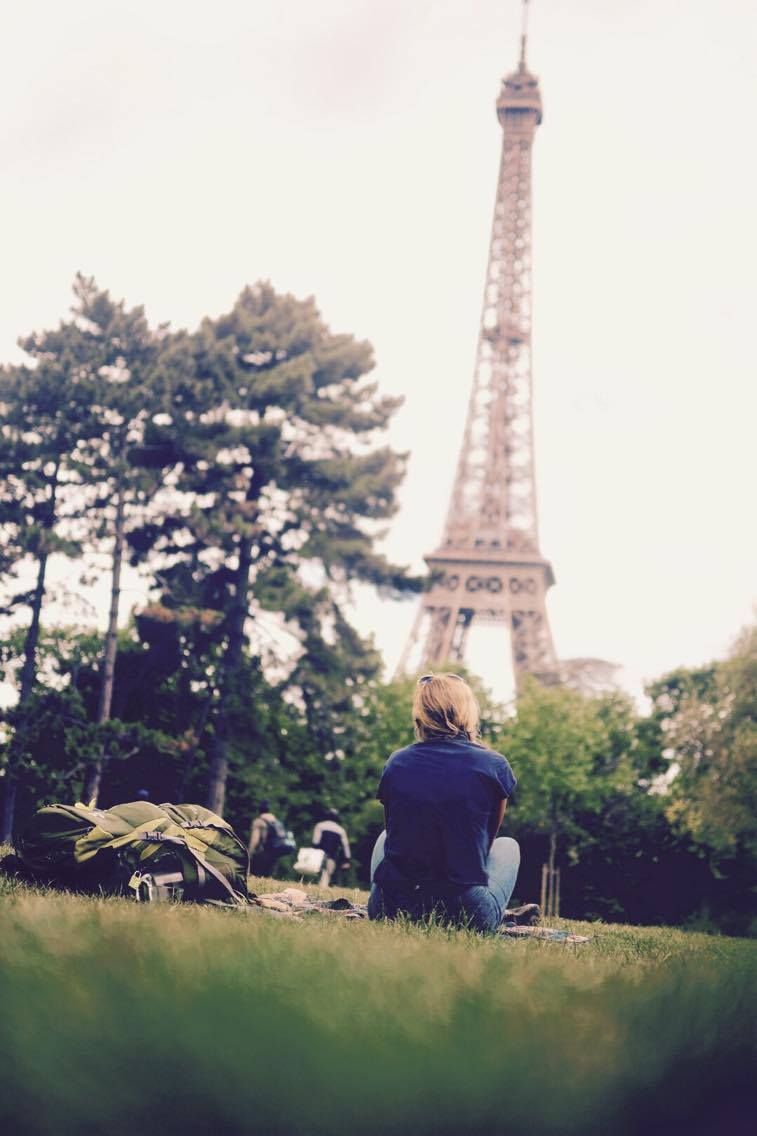
I left Penmarch early in the morning to get to Paris in the early afternoon. The train ride was long and I was exhausted from hardly sleeping the night before. As sad as I was to leave the Manoir du Ster, I was also curious and excited to finally be in Paris and explore the city that I had wanted to visit for such a long time. As the train rolled into the station, I looked up what direction I had to walk in to get to the Tour Eiffel. As I started my walk from the train station, I was amazed by the architecture of the houses that lined the streets, by the feeling of this city, and finally by seeing the Tour Eiffel, far off in the distance.

Rather than taking lots of pictures, I concentrated on walking. I had the map that I picked up on the airport, so that I did not even have to take out my phone to look at the directions. I did get lost a few times, but there is no better way to explore a city than to get lost in the side streets. Eventually I reached the Tour Eiffel, tired and with aching feet. I had underestimated the strain of walking with a heavy backpack, but being able to sit down in the park was worth the effort. I stayed and rested for a little bit, before heading to the metro.

Again, I underestimated the distance to the metro station. I walked for another hour and a half before I got to the metro station where the metro would take me to my hostel. Or so I thought. It had started raining while I was walking and I was very tired. As I walked down the metro steps, I read: Entrance only with Ticket. Underneath the sign was an address to buy a metro ticket. I was frustrated. I had planned out how I would get to my host all and had neglected to look up how to buy a ticket. As I learned later, you can buy tickets at most stations. That afternoon, however, I wondered around for half an hour in frustration and exhaustion, unable to figure out
how to buy a ticket for the metro. I felt so stupid! Here I was, I had managed to get by in the Bretagne knowing very little French, I thought I had gotten better, and now I couldn’t even buy a train ticket. Good job. I was really close to giving up and just sitting on the curb, but it was raining and I had to get to the Hostel to check in. I ended up walking another 3 km to my hostel. In total, I must have walked about 12 km with my backpack that day. When I finally got to the Hostel, I was dead tired and could not wait to put on my comfy sandals. As much as I just wanted to lie down in bed and sleep, I knew that that would be a mistake. After all, it was only 6pm, and it had stopped raining. I left the hostel and wandered through the surrounding streets, coming across so many little restaurants and cafés. I bought fruit and a tomato at a little grocery shop and ate a light dinner.

I was so tired.

After walking through so many little streets, finding a little bookstore and buying a little book by Albert Camus, I settled down in a bar,  drank a glass of wine, and wrote down a few summarizing words of the day…

Feelings right now: 
- Tired
- Lost
- Grateful for the beautiful moments
- Paris is too big to feel like home
- My head hurts

I forgot about that…I had such a bad headache from walking around all day and not drinking enough water, and probably stress and too little sleep too.

Goals for tomorrow:
1. Remember Amelie
a. Self are is necessary
b. Recognizing emotions is, too
2. Take good pictures
a. Find the angles and color contrasts
3. Find 5 stones to skip
4. Don’t be afraid
a. To get lost
b. To feel lonely

Goals for Paris:
1. What does it mean to be OK with my own company? 
2. Relearn to look at life with curiosity
3. Be the observer; it is ok to be passive, too
4. Smile. Smiling never hurts and I’ve been frowning a lot the past few days, I think.

These were my thoughts for the next few days in Paris. I think it helped me to create an emotional roadmap. I was feeling very lonely and sad that evening, sitting at the bar by my self. It was such a stark contrast to come from nature surrounded by loving individuals, and all of a sudden be in such a big city surrounded by thousands of strangers. I felt invisible and small that night, like I didn’t really matter, and it was a strange feeling because I so much wanted to soak up and feel the beauty of Paris.

On a side note, the hostel that I stayed in was terrible. I stayed in a three-bed took for two nights and we only had one key. It was frustrating because it meant very little independence, especially later in the evening.

I slept like a baby that night. It was good that I went to bed around 10, because I woke up around 8 the next day and felt refreshed. The first thing I did after taking a quick shower was to look at the (included) breakfast at the hostel: coffee and pastry from vending machines. Very questionable and a lot of sugar. What really made breakfast better was the company of an elderly man from Chile who, after talking for a few minutes, gave me his email address and said I was always welcome to come visit him in Chile if I was ever there without a place to stay. This incredibly kind-hearted man and coincidental interaction put me into a very good mood. When I went back to my room, my one roommate was just packing her things. We started talking (she was from Melbourne, Australia), and she told me that she had been robbed the day before. Even though she had lost her passport, credit card, and money, she was not upset because she had not been hurt and told me that with 60 (ish) years old, all that really mattered was to be in good physical shape and healthy, that she had grown up in Singapore and never seen nature until she married a man from Australia, and now spent her time traveling as long as possible. I admire her for her strength and positivity. I am not sure I could have been as bright and loving, as caring and understanding of the circumstantial situation she had found herself in. All she really hoped for was to get her emergency passport as soon as possible to continue traveling. She told me much about finding your identity – or rather, not finding it because it’s not about the end goal but about the path that we find ourselves on and about trying to improve every aspect of yourself while figuring out how to stay true to yourself.

After talking for quite a while, I packed up my things and started walking. My plan for the day was to make my way to Montmartre, the quartier that Amelie takes place in (my all-time favorite movie that is seen as very stereotypical in France) with my paper map. As I walked and walked, I crossed the Place du Bastille, passed (close by) the house of Victor Hugo, I crossed the Place de la Republique. I walked alongside a courtyard with beautiful, old buildings and passages that reminded me of the plazas in Spain, and I found a little jewelry shop where I bought a necklace and talked to the owner for about half an hour. She gave me some ideas and tips where to go and was such a friendly person that I immediately felt welcomed and much more at peace in this city that I had thought of as “too big to feel like home” just the night before. I was also so proud of myself for maintaining a conversation in French for such an extended period of time, when just weeks before I had not been able to say where I had to go. I felt so much positive energy walking through the beautiful streets of Paris.
I had a rather weird encounter in another jewelry shop where I was looking for a pendant: I did not see a sign at the door that the jewelry was only sold by the 100s, so that the sale’s woman rejected my intention to buy just one piece in a rather unfriendly tone.

I kept walking and marveling at the buildings and architectures. I made a point to avoid busy streets, and found another book store with used books, where I bought an old copy of Le petit prince.
Even though the weather was quite unstable and it rained for a few minutes every now and then, the sun was shining as I started walking uphill with a view of the stunning Sacre Coeur. I felt like I was walking on clouds, like I could skip through the streets with a smile on my face for the last few kilometers up to the basilica. I felt so happy to finally see this part of Paris!
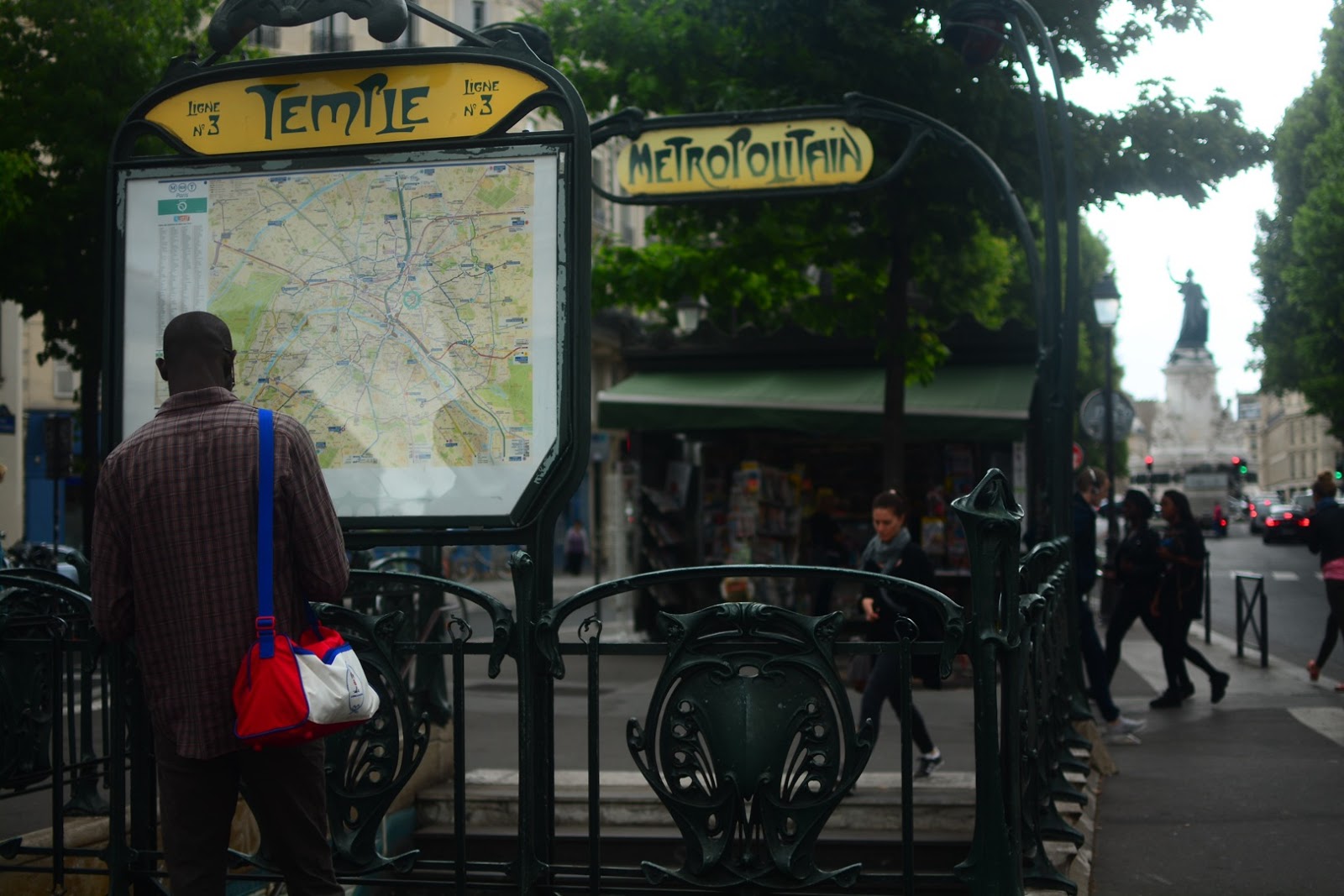
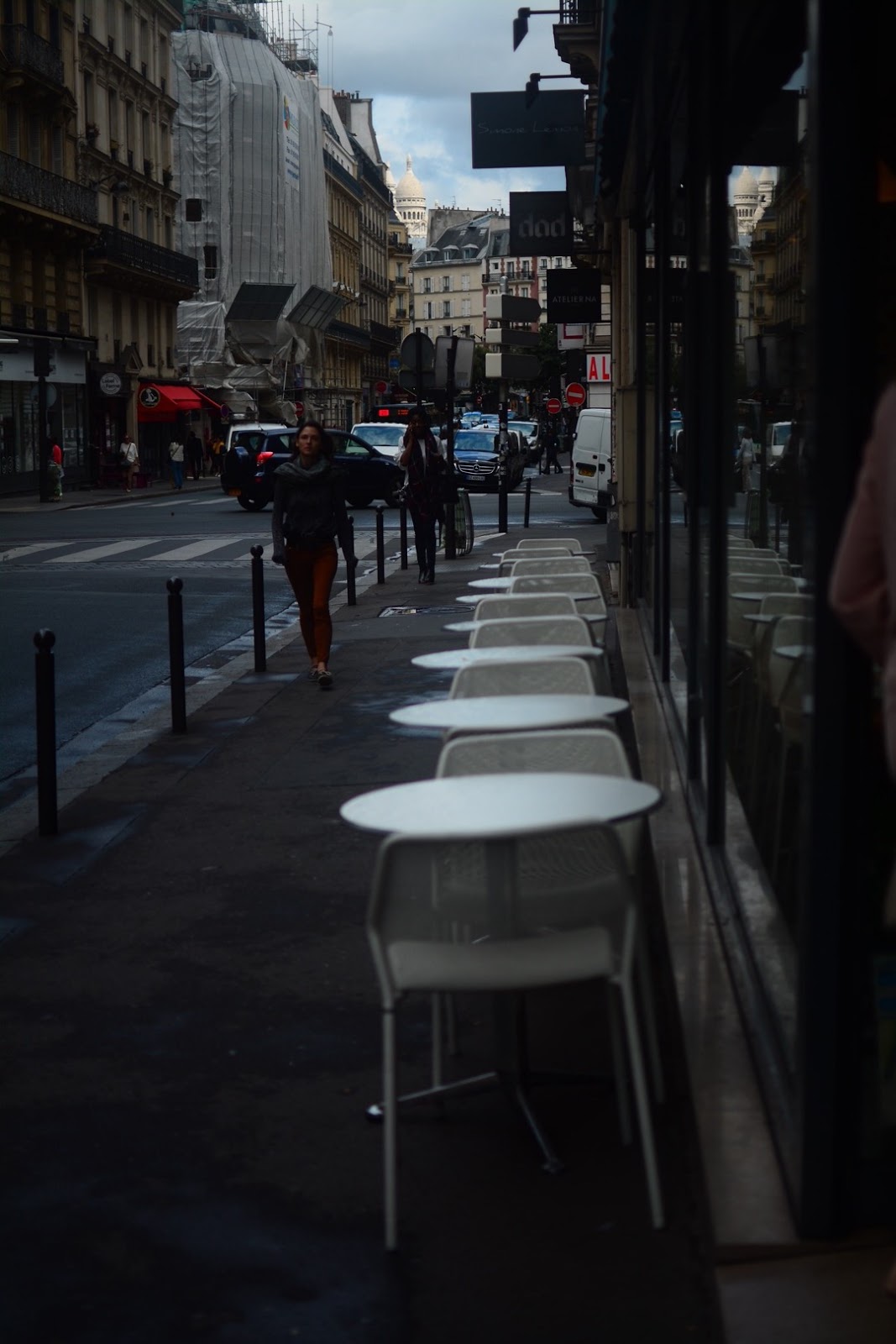

As I entered the Cimetiere de Montmartre, a guy started calling after me. At first I payed no attention to him, but he insisted and started walking next to me, talking to me in English. Only because I was in such a good mood did I respond to him, and he accompanied me for a little bit. After a while I told him I wanted to keep walking by my self.
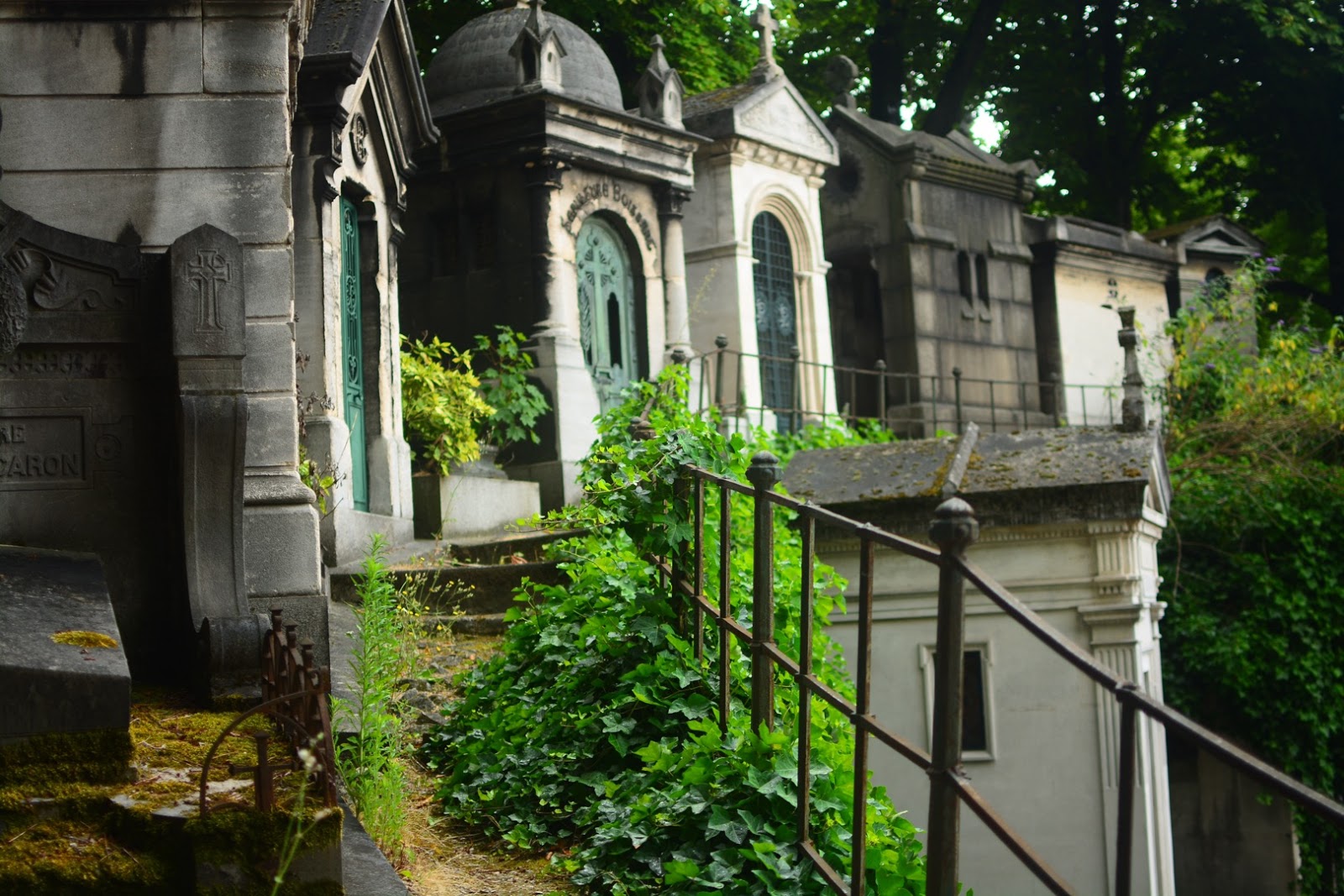
At first I thought that I had missed out on taking in the quartier because I felt limited by his company, but I ended up staying for four hours. I fell in love with this part of Paris, so much more than with the center. Of course, it was also very touristy, but the feeling was so different, so much more cozy. Some streets were lined by cobble stone, the houses leaned lazily against the incline of the hill, and the steps that steeply climbed up narrow streets every once in a while.

Of course I had to stop at the famous Cafe des deux Moulins, where 'Amelie' takes place. I drank a coffee and stereotypically ate a creme brûlée like Amelie does in the movie. It was such an honor to sit in the little cafe, even though it was after all very different tan in the movie. It felt unreal never the less, and it was a dream come true for me. I stayed for quite a while, collecting my thoughts once more and jotting down a few words to make a note of the impressions and most of all the interactions of the day so far. It was quite surprising because I realized that I had started to think in French, even if just with my very limited vocabulary. I realized that I was really making progress. I wrote my notes in French, and even though I am sure that if I ever manage to master the language I will look back and laugh at what I wrote, I am still so proud that I was able to put together words to form sentences and put together sentences to form paragraphs and jot down my impressions.

After leaving the cafe, I made my way up to the top of the hill, and once again felt overwhelmed by the beauty of the Sacre Coeur, as its beautiful dome emerged in the sky above the houses. It was another moment that is so hard to put into words.
                                                   

There were many tourists waiting in line for the tour of the church, and as much as I loved the view of Paris from the top of this hill, I made my way back down into the winding streets o Montmartre. I got lost, but again trusted that the city would take me where I had to be. As I took a picture of the streets, an old man came up to me and asked it I was a photographer. I told him how much I love photography, and he asked me where I was from. After a few minutes of friendly small talk, he asked if I had plans for the night. I told him no, and he asked if I was visiting the city by my self. When I said yes, he informed me that there was a cabaret club just next door that he was part of, and that he would invite me. He even showed me what metro I had to take to get back to my hostel. He was very kind. I was going to go, but my plans changed.

After walking around the quartier just a little bit longer, I went back to the Sacre Coeur because I had not yet skipped down the winding steps. I watched, fascinated, as storm clouds formed in the distance over the city, before I ran down the wide steps. It was such a feeling of liberty, almost like my feet were not even touching the ground, almost like I was still just skipping on clouds, my skirt flying around me with the movement of my legs and the wind…It was beautiful. I stopped on the place by the little carousel. I had always imagined it to be much bigger… I sat down on the steps because right by the carousel was a public piano that a young man was playing. It was an atmosphere of peace and tranquility. I looked again up at the Sacre Coeur, listening to the jazz tunes that the young man was playing. I took a few pictures and a video to capture the moment, and then packed up my things to keep walking, this time with the goal of the Gare de l’Este. As I walked away from the piano, some guys came up to me and tried to sell me a bracelet. One of them grabbed my rest and I got very uncomfortable, aware of my position – alone surrounded by a group of guys with my camera over my shoulder. I did not feel right for this stranger to grab my wrist. He did not let go even after I asked him to. I got scared. He noticed. I struggled to free my hand and walked away very quickly. I heard footsteps behind me and thought that the man was following me, I turned around, my discomfort probably written onto my face. It was not the man who had been holding on to my wrist. It was the piano player who called out to me in Spanish. Out of reflex I had talked to the other guy in Spanish. I was surprised. The piano player seemed much more friendly and I was relieved that it was not the other guy following me.

I talked to the piano player for quite a while, walking around the place at the bottom of the Sacre Coeur. I told him that I wanted to walk to the Gare, and he told me he would show me where I had to go. He ended up walking the whole way with me. It turned out that his English was perfect and we had really nice and interesting conversations, about Parisians and how they are very sad people even though they might not want to admit it, or always show it, but that in the end they carry much sadness around with them deep down. We agreed that, in the end, the busyness of the city and the lack of meaningful human interactions enhances this sadness.

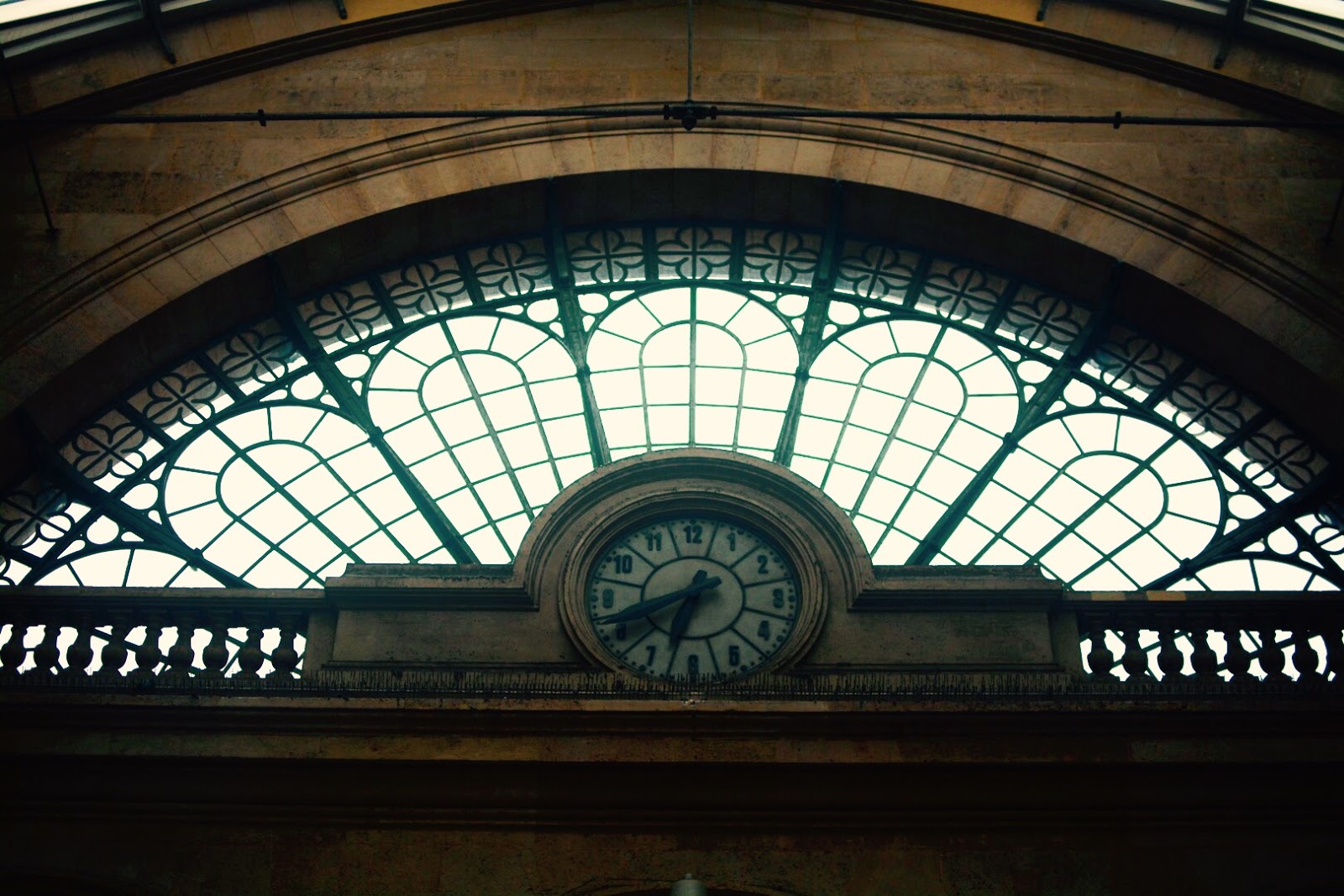
We walked to the Gare de l’Este (one of the train stations) and I went inside for just a second to take a picture of the clock. I was really tired by that point – I had been walking for almost 9 hours straight. I still wanted to see the canals that snake thought the streets near the Gare, but had reached my capacity of taking in things around me. The piano player asked if he could accompany me some more, and I said that would be nice. It was a nice change to walk without looking at a map and not get lost. Especially since I had lost my physical map. (I was looking forward to have a souvenir *which means memory in French* with all the places I went to marked in red and purple marker).
We ended up walking quite far along the canal, which I had imagined to be much prettier. Maybe I will go back and look for a nicer corner of the canal. Either way I skipped my stone, which was one of my goals. I didn’t find five stones, but at least one to skip. We the sat on another place for about another hour or two, by which time I had missed my rendezvous with my 80ish year old friend from the cabaret show. It wasn’t too tragic though that I missed it, especially because I was not 100% sure if the invitation had been serious and because I was far away.


That night I got back to the hostel around midnight because I could not not walk by the Seine at night. I was not at the prettiest of bridges, but it was still a detour that was worth it. I fell into my bed that night, again dead tired but also so grateful for all the beautiful places that I had seen and the amazing people that I had met.

The next morning I got up, went out to drink a cup of coffee (for 6 Euro!!! I had ordered a glass of wine for less the night before). I also bought the best olive baguette that I have eaten in my life. It was so good! A I walked back to the hostel, I also came across a market and bought some fruit and an avocado. I couldn’t resist. It started raining pretty badly, which made my walk less nice. I packed up my things at the hostel and took a metro back to Montmartre. I just really loved it there, and I had a few hours to kill. It was pouring when I stepped out of the Metro. Good thing I had a rain cover for my backpack. Even though the weather was really terrible and my backpack was heavy and my feet hurt so badly, I kept walking through the streets, climbing up the steep steps bravely, trying to soak up every last detail. I really wanted to eat a crepe before I left Paris, so I started looking for a Creperie. I remembered that the day before, when I was walking up Amelie’s road, I had seen a little Crepe stand. I found it and it was such an amazing feeling to walk in the cold rain with a warm banana Nutella crepe in my hand. It was such a moment of happiness.


Had I not had my backpack, I would have sat down in a café and avoided the rain, but I felt that it would be a nuisance to enter a café with my hiking backpack, completely soaked. I ended up finding a little park where I could hide under the trees until I had to leave to go to the train station and catch my train to Bruxelles. I got a message from the piano player – he wanted to say goodbye at the train station. It was sad to leave Montmartre.


I waited from the piano player by a grand piano at the train station – how amazing is it that there were just public pianos everywhere throughout the city????? – where I met another man who was taking his 2 year old son to Bruxelles. He was also very kind, and even said he would show me the way around Bruxelles. I played one or two songs, at first with shyness, while waiting for the piano player. I almost missed him because I had to board the train, but last minute he did show up. It was nice of him to say goodbye to me!

I ended up finding a seat next to the father and son, and we coincidentally realized that I was going to stay just a street away from him.  

Thursday, July 6, 2017

Soulanchor

I have not had much time to calmly write in the past days. I am now at my grandma’s house in the north of Germany and have time to reflect.

*I want to just document that I am sitting in the living room with my grandma; she is watching TV with her headphones, I am typing. Even though I am not watching the movie she is watching, even though the sound is muted for me, she occasionally comments on what is happening, as if I could join in the conversation and comment on the plot of the movie with her. It is very funny to me. I am so happy to be back here, the place where I spent so many days of my childhood and that feels so cozy and homely, like a warm blanket that hugs me.*

There are so many things that I wish I could document and put into words from the three weeks that I spent in Brittany, so many moments that I hold in my heart. I have been keeping a travel journal and wrote down beautiful moments every day to not forget, but let me summarize at least a few of my favorite memories.

I cherish the memories of breakfast with Helene and Dominique every morning. It was such a nice start to the day, chatting with them a little bit, getting updates on what Helene had already done – mostly clear out the dishwasher and put out the pot to heat up milk for Dominique’s café au lait. I really miss Helene’s positive, cheerful attitude and the way she would laugh and get excited about the birds flying around the kitchen, and how she would point out all the new (and old) spots of dirt on the kitchen counter and tell me “ohhh Lena, cochon!!!” (Which, literally translated means pig).


I also am so grateful for all the times that Sophie took me out kayaking. Every time we went, the ocean felt different, we saw different things, we went different places. I’m not sure I managed to captivate how incredibly emotional the immense beauty of the ocean was to me. So many times I started tearing up just because the color of the water was so overwhelmingly full, because the reflection of the sunset tinted everything around us in an orange glow, because the waves of the ocean first made it seem like we were on an amazing adventure in the middle of a storm (going against the waves), and then trapped in the closed palms of a sleeping giant as we were paddling with the waves and seemed to be going nowhere, controlled completely by the enormous body of water beneath us.
It was beautiful to see Sophie play and swim with her baby seal. It was beautiful to feel the seal nibble at my feet in a gesture of trust. And every time again, eating banana bread was delicious out in the middle of the ocean.
The last time that we went out to kayak, Emma came with us again. After having a hard time the second time she accompanied us (I did not realize that she did not know how to steer and let her sit in the back because I misunderstood), Sophie and her went in the big kayak, and I got to use the smaller, one person kayak. It was a very different feeling to be in a boat alone. At first I was a bit unsure, but I soon figured out my rhythm and ways to navigate, and from then on loved the meditative quality of being in control, slipping through the very calm waters. That trip, we did not find the baby seal, but we went to a different rock collection and sat there for a while. I am connected and anchored to that little stone island. I left a part of myself there, and took a part of the island with me. I climbed around a bit, and stood at the side of the rocks facing the open ocean. The water was so incredibly blue. And the clouds so white, and the waves were crashing rhythmically against rocks further out in the ocean. It’s a place I will never forget.
And I will not forget, either, sitting with Sophie and Emma in tranquil silence eating banana bread.

I think I need the ocean to calm my soul.


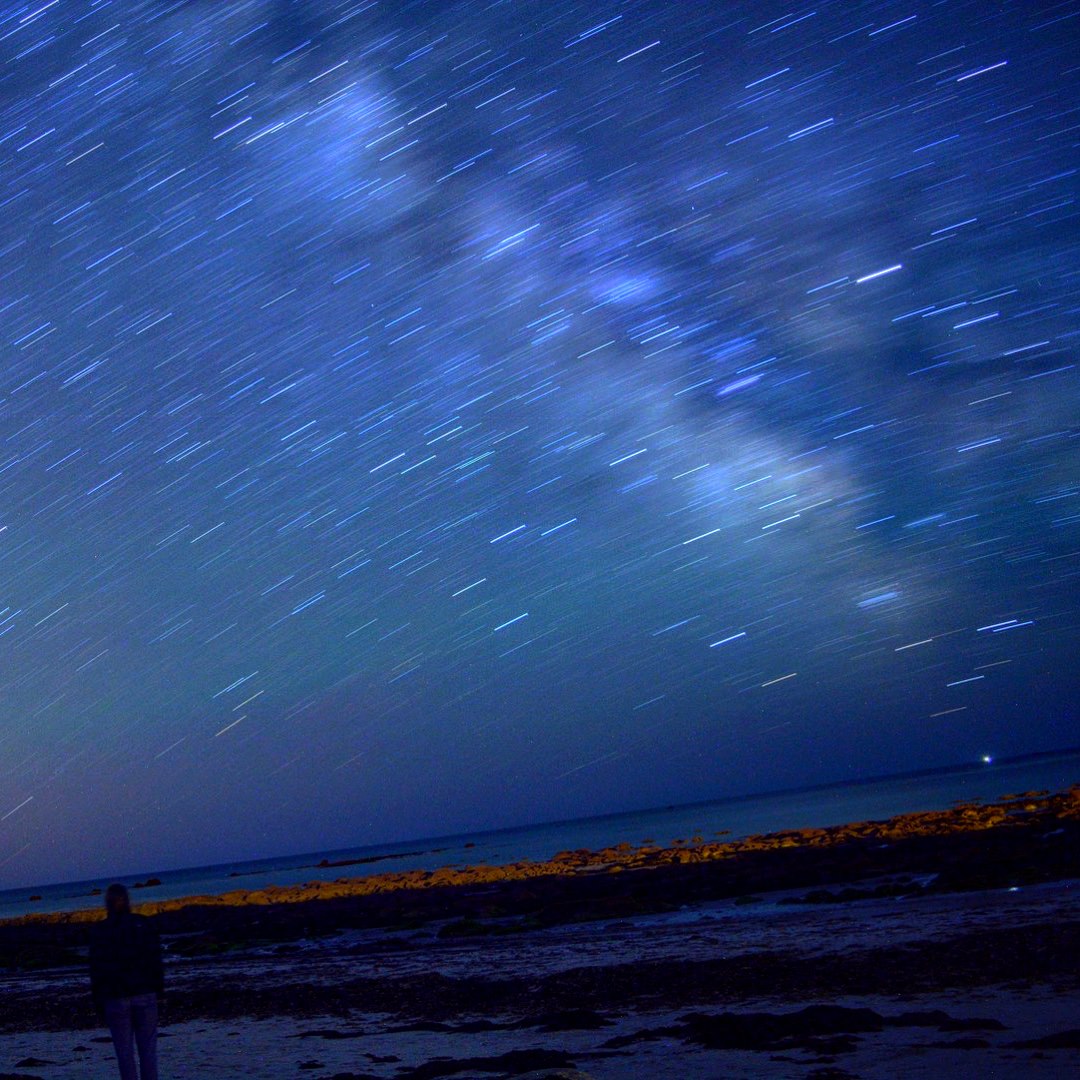
I got up a few nights to watch the stars over the water. What immense beauty. There is nothing quite like staring up at the sky and realizing how small you are, how much there is still out there to discover, and yet how connected we are to nature and the rest of the world. I stood looking at the sky taking pictures for hours. The first time that I got up I was so overwhelmed with emotions. I hadn’t prepared myself for the sight of so many stars and such beauty. I remember standing at the edge of the little path that lead to the ocean, heart beating, tears in my eyes because again I realized that I still have so much to live for – and yes, there is beauty everywhere – but sometimes it takes the sight of a million stars to remember that there is still so much to see. That moment I was full of gratefulness for life; for my life.

I am also grateful that I got to share the view of the stars. Merci pour marcher dans la plage avec moi, pour dancer, pour rester avec moi et pour touts les instants après…

I have not talked much about the actual work that I did. I cooked a lot, for Sophie, Helene, Emma, Joel, Dominique, and myself. I loved cooking. Even though I got nostalgic many nights, remembering my work in Bolivia, pealing potatoes, cutting tomatoes…little things like that.  I also cleaned a lot, the Windows, the kitchen, the yard. Cleaning was a really meditative thing for me to do – and one of the few things I did not need much French instruction for. Especially getting rid of weeds in the yard was really nice because it was so physical and gave me the feeling of progress after seeing a tall pile of green behind me.

I cherish hearing Emma play piano. She is a genius.


About halfway through my stay, we celebrated a day of art. About 15 local art-students from a public art course came to the Manoir to do work, to later exhibit their art at a party (that sadly I missed because I left the Manoir too early). The day was a beautifully hot day, and I did some art myself. Seeing the (mostly) elderly artists doing their work reminded me much of my old neighbor Phyllis, and how we would sit and do art together when I was a child. As beautiful as the day was, this was also a time of frustration for me because I was growing so comfortable, yet feeling my limitations in terms of communication more than ever. I had made such progress in only 13 days, and yet I hardly understood –and especially misunderstood – much. It was frustrating to get things wrong and I felt bad for my mistakes, even though I knew that I would not do everything perfectly. I am grateful for the patience of everyone who I worked with. I know it was as frustrating for you as it was for me at times. Thank you.


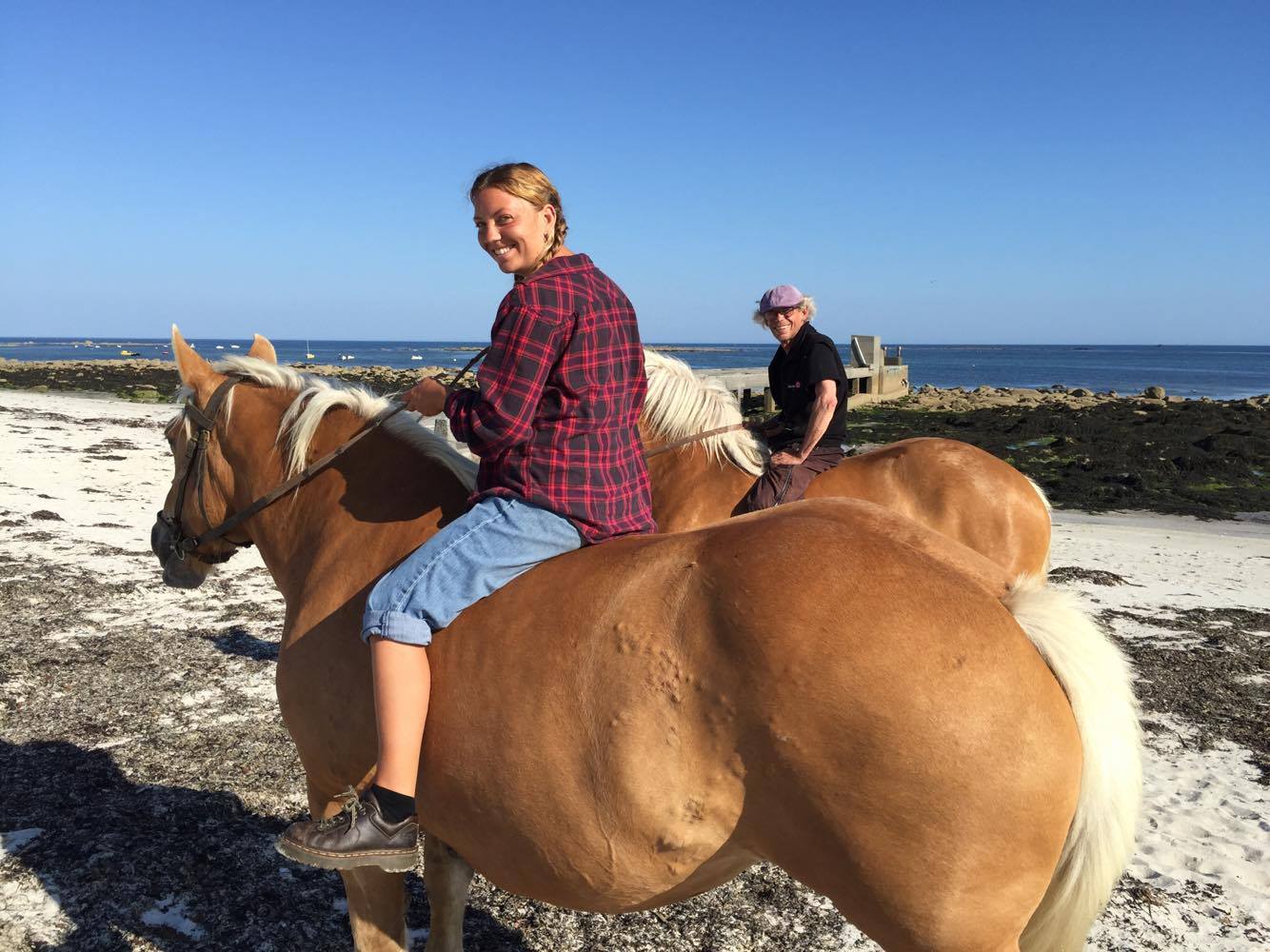
I fulfilled my dream of riding a horse on the beach. This could not have been more peaceful and beautiful. I am so in love with this memory. I had not ridden a horse in years, and here I was, riding bare back and on the beach. The second time Joel took me to take the horses out challenged my courage and fear of falling: the horse I was riding was nervous and did not react well to my (very poorly executed) commands. We were on the path next to the beach, when she started to trot very fast (or maybe even gallop). We had been in the water and her fur and my pants were wet, which meant that I had very little hold and balance. For a few seconds I was scared I would fall, but I remembered that there is not much I can do but go with the motions. As I urged her to slow down, I tried my best to hold on until she stopped. It was an experience of loss of control and adrenalin that I enjoyed even if I was also nervous of falling. It reminded me that even though I can feel in control, I most likely never completely am.

Dancing. Dancing, dancing, dancing. I won’t ever be able to express how much joy I get out of dancing. The night of the art’s day, we also had a little concert. The musicians called for the (very small audience) to dance, and I was shy at first, but then started to dance with Joel and later got everyone up to dance as well. It was so heartwarming to see couples dancing, and then to dance in a big circle. I danced by myself, too, just feeling the music in my body, moving with emotion. That night, I really wanted to dance with Helene, but she was having trouble with her arm. A few days later, just a few days before I left, as the artists were setting up their exhibition, Sophie put on salsa music in the Studio. Helene was in a good mood because her arm was finally getting better. She nudged me with that bright smile of her’s, because she probably saw or felt me swaying to the music. I finally got to dance with her! And I never want to forget how happy and giggly she was when she skinned herself around my arm, how she kept saying “ohh Lena, to dances bien!!!” It gave me life to see her so happy and to get to move to the music.
I also danced along the beach at night, under the stars, with big movements and turns, just to the music in my head, and later to the light of the lantern next to the beach and the music of Systema Solar.


Sheep. I miss them so much. I loved to sit my my room as the sun went down – just around 23:00 – and watch the sheep graze in the last rays of light. The male sheep would come visit me by the door and rub his head against my hand, and occasionally bump me with force. I actually realized that the cat would do the same to get my attention: she would forcefully ram her head against mine! Anyway, the sheep…Mom open a sheep farm in the Bretagne with me? Please?

Running, I took time for myself and my body. I know I feel much better when I run. And I was eating so much! It was beautiful to run by the seaside. I ran in the morning maybe twice until I realized it would be much better to run in the evening. I ran into the dusk, looking at the beautiful reflection of the sky in the ocean, climbing a tree to feel connected to nature, and also feeling rain on my skin as the weather got worse the last two days that I was in Brittany. Running, too, gives me energy. Even though it exhausts me in the moment and it is strenuous once I fall out of a routine. I feel and am so much stronger when I run.


Quimper, the city of little streets and old houses that made me feel so at home even though I had never been. I visited the city one of my last afternoons and it was worth the hour-long bus ride. In a way, this visit foreshadowed my time in Paris: walking around the streets without a clear direction, exploring and curiously seeing where the roads take me. That is really the only way I know to explore a city. I trust that I will get to where I need to be, to whatever it is I really need to see. I always end up finding the most beautiful corners of places. Quimper gave me the opportunity to take in something different than what had become ‘every-day-beauty’ of the ocean, and at the end of the day returning to that beauty, once again tearing up as I walked into a beautiful forest of pine trees that I had never seen before because I got off at the wrong bus stop (on purpose) to walk along the beach back home to the Manoir. While I love the city, nature gives me much more life and I crave the tranquility already. I ended the day eating bread and cheese on the beach, cutting the cheese with a ‘mule’ (mussel) something that Sophie and the others later laughed about a lot. The evening gave me time to reflect on the very little time that I had before leaving. I realized how sad I was to leave this place of beauty, and how attached I had grown to the people around me. I open my heart and take up the world fully. I would not want to live any other way than with complete honesty giving every bit of me, but it hurts so much more to leave. Sitting on the beach watching the sun go down, I admitted to myself, too, that I was scared to lose the peace I had found in the Bretagne. What if I would leave and the inner peace were to go away? I didn’t really want to change the free non-society-conforming-ways I had adopted while living by the beach. I still have not shaved my armpits and wash my hair every 4 days, instead of every other day.

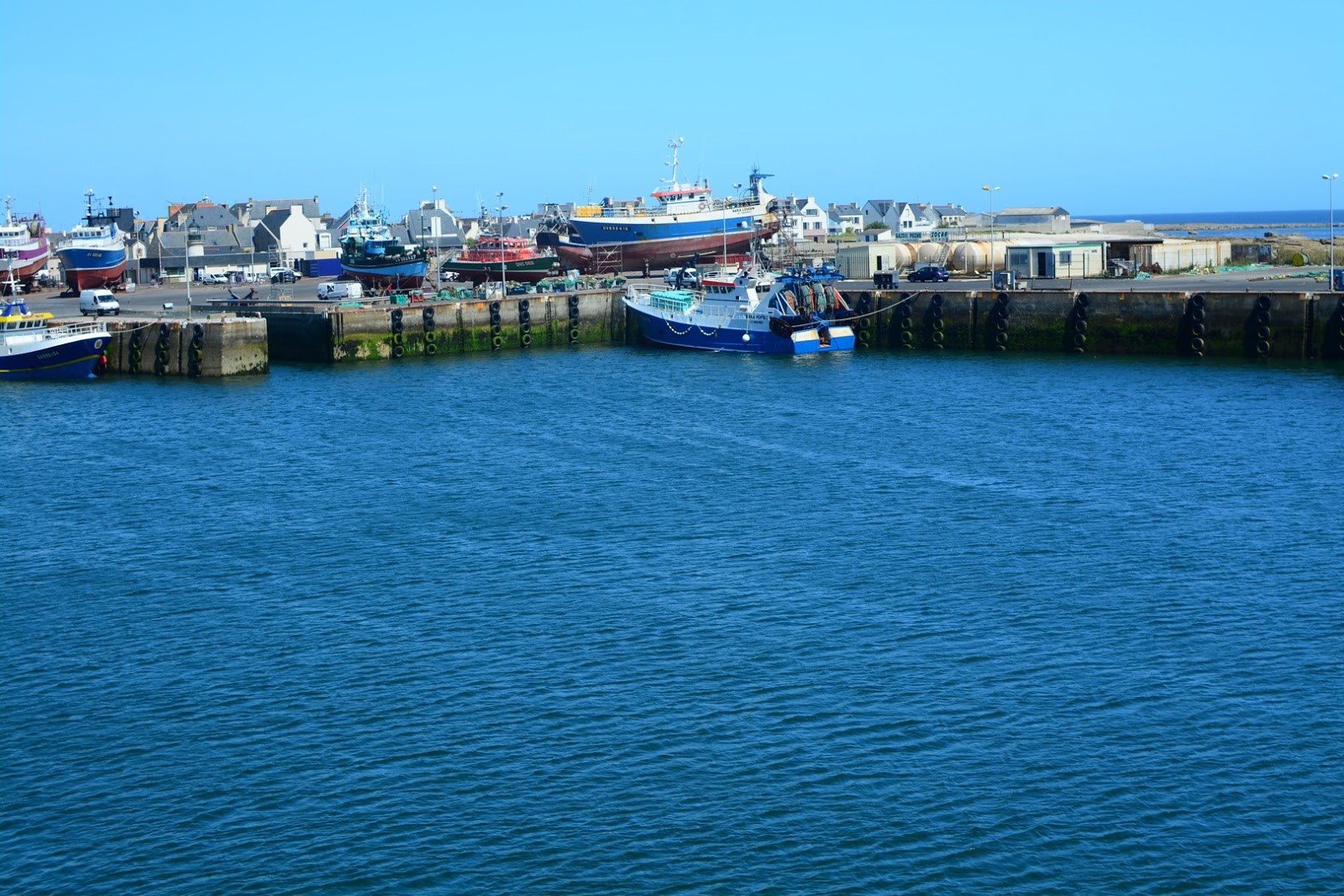
 (Gulvinec)


Emma seemed to have been inspired by my energy. The last few days she kept asking me what she could do to live healthier. I showed her how to yield up some core strength and suggested to drink water instead of snacking. The day after I told her about core strength she proudly told me she had done the exercises. I am so proud of her for being motivated!

My last day at the Manoir was one of such bittersweet joy and sadness. I walked by the beach tearing up, knowing that this would be the last time that I would see this beauty (I came back another three times). I still want to go back. Saying goodbye was sad but also beautiful. I had made little gifts for everyone and written letters in French to share my gratitude for the three weeks.
In a way I wish I could have stayed another two weeks – I think that I would have made so much more progress language wise, but parting would have been just as hard, if not harder.

I took such a risk in coming to the Bretagne, not knowing who I would encounter, not knowing what work I would be doing, not knowing how to communicate. I met the most amazing people, and I carry a sense of peace within me that I did not dream of finding. I found, I think, some of my roots in a place I had never been before, that nevertheless felt like another home. I am adding the Manoir to the list of places I call home. And I will return, mentally and hopefully as a part of my future travels. It is too early for me to know what impact these three weeks really had on my development and on my sense of self, but I feel that something shifted within me. Maybe this shift is not long-term, but to be able to say that I found peace for three weeks is a gift that I did not expect.

I also never though that I would love French so much. Barry, nous allons parler beaucoup le francais et aussi voir les films francaises s’il te plait, d’accord?

-----------------------------------------------------------------------------------------------
Paris, la ville de mes fantasmes….

I wanted to come to Paris since I was 12. Anyone who knows me well enough knows how much I love ‘Amelie’ it has taken me ten years to fulfill this dream.

The first afternoon and night in this enormous city was a mix of awe and loneliness. It was a shock to come from nature to such business and such crowds of people. It was disorienting at first. And I was so exhausted after walking with my backpack for 4 hours and very little sleep, I think I had a hard time to really take in everything that was happening around me. After setting my backpack off at the hostel, though, I took a little tour of the quartier, and was fascinated by the little cafes and brasseries everywhere. This is special in Paris, I think, and gives the city such an air of comfort…and yet, threat fist night, drinking wine at a little bar, I though “Paris is too big to feel like home”. And yes, that feeling did not go away, as I did not spend enough time in the city to make it feel smaller.

As lonely and lost as I felt that first night, I met so many beautiful people the next day as I walked for 11 hours through the streets of Paris…


Of those adventures I will write another day.


Sunday, June 18, 2017

Critique of Donald Miller II

Continuation of Reflections on "A Milion Miles in A Thousand Years"

“I forgive you” (153).

Excuse me?

[context: Miller talks here about forgiving his father whom he has not seen in 30 years and who has been largely absent from his life]

Agree or disagree with me, but forgiveness is not something that just happens within a few seconds, in my opinion. Sure, at an earlier point in the book Miller comments that he forgives his father because he does not even really know what to forgive him for. But if he were completely indifferent about his father he would not have taken so much time to find him, nor would this act of looking for him have been such a large challenge.

I don’t know. Maybe for some forgiveness is this easy, just saying “I forgive you” and voila.

For me reading this one simple sentence however was rather upsetting and I thought that it sounded too simple in the context of the rest of the story.

“Part of our selves is spirit” (153).

Yes. Much of ourselves is spirit, soul, aura. Something like that.
“It was good pursuing a girl” (154).

No no no. Why do you have to pursue a girl? Why objectify women in that way? Pursue a relationship, sure. Pursue the love of your life. Pursuing means there is an object to be pursued – women are not objects.

“The more difficult, the better the story” (156).

YES. It’s better, but also harder. But through harder stories you’ll (we will) also grow more.

“If I hadn’t done to Peru, nobody would have died. And if I hadn’t seen my father, the fate of thousands would not have been affected” (157).

Ok. That’s exaggerated thinking. Yes, Miller here is talking about what makes a story epic. But if you are basing everything off of whether the life of other’s would otherwise be in danger or not you are missing an important aspect of life: that it’s about growth, not about all of a sudden doing something glorious that saves life's every day. That really is the material that movies and superhero novels are made of.

I think the question should much rather be how to live a life that inspires the lives of others and impacts others positively? Will my actions today make another person smile?

And sometimes it is just important to realize that you yourself might die—metaphorically speaking—in the absence of an experience like going to Peru and challenging oneself. Because without such experiences we do stay stuck in our routine, in the comfort zone.

Talking about Bob Goff and his wisdom, Miller cites that Bob said “[I don’t think] we should be afraid to embrace whimsy…that nagging idea that life could be magical; it could be special if we were only willing to take a few risks” (167)

First of all, I want to be Bob. He sent out letters to world leaders and asked them for interviews and then said they were always welcome at his house. He makes (unofficial) peace contracts and asks for diplomacy. And I absolutely agree with his words. Let's all embrace whimsy.

“You can either get bitter, or better. I chose to get better. It’s made all the difference,” said one of Donald’s friends (181).

Let’s all get better. That doesn’t mean that it takes more energy and strength than all of us think we have. That doesn’t mean that it’ll just be a walk in the park or that it won’t take time. But it does meant that the alternative is to get bitter, and I really do think that that is true, that one internalizes all the shit that goes on in the world and become cynical and give up hope that there are still good people out there and good moments to be lived.

Becoming better (whether that meant to recover and revive, or simply become a better person, become even more amazing), does not disregard the problems that we face—it simply means not giving in to problems and giving up before the start, giving in and becoming (or staying) passive. Becoming better means to face challenges with courage.

Victor Frankl states that “life, even amid the absurdity of human suffering, still has meaning” (196). I really want to read Frankel’s book. He was a psychologist who survived the holocaust. “Life is a persuade of meaning itself, and … search for meaning provides the basis for a person’s motivation,” writes Frankl, and I agree (196).

“When you stop expecting people to be perfect, you can like them for who they are” (206).

Yes that is true, I think. I think that making an effort to stop looking for perfection and, in turn, cherish humanity and uniqueness in everyone you meet is essential to forming a better community.

“The most human of human beings within twenty miles was sitting across from me” (223).

No, no. However “human” the person was in the moment, this statement disregards the humanity of every other person within that twenty-mile-radius. We are all the most human of human beings if we let ourselves be. It might be easier for some to open up and show feelings than for others, but that in itself does not make them less human.

“It wasn’t necessary to win for the story to be great, it was only necessary to sacrifice everything” (231).

Give it your best. Then, mo matter what the outcome might be, there is something you can say; that you have given your honest best. That’s what my mom taught me.

“I know there are biochemical causes for some forms of depressions, but I wish people who struggle against dark thoughts would risk their hoes on living a good story” (247).

While there is a grain of truth to this statement—that it would be great for everyone to take risks to live more meaningful lives, the issue is that people with depression do not have the energy to take such risks, or feel that it doesn’t make a difference, and that it is incredibly hard to break out of such a cycle of thoughts. This makes a statement like the one above meaningless, since it disregards the difficulty of depression.

I was quite unhappy with the end of this book. It was rather uninspiring. It also bothered me that Miller states that he wrote the book in a rush. It makes the (inspiring) things he wrote feel less meaningless and written without meaning. Maybe I am too critical.

What do you think?

Friday, June 16, 2017

Critique of Donald Miller I

Reflections  on “A Million Miles in  A Thousand Years”
[Spoilers for those who haven’t read the book]

This book by Donald Miller was given to me as a thank you for leading a retreat last October, by my mentor and friend, Lauren. At the time, I was busy with school work and had about 100 other things to read, so the book collected dust on my shelf for a few months until I rediscovered it as I was packing up the things in my room to move back to my parents’ house for the few weeks before heading to Europe. The subtitle of the book is “How I learned to live a better story,” and I thought that it might be just the right read for two and a half months of traveling and backpacking with just the bare minimum (in truth, the necessary) of things in my bag.

As I hadn’t read much for my own (novels or short stories) over the past few months, and have formed a habit of annotating most things I read over the years that I have been studying, I felt the need to pick up a pen as I started reading Donald Miller’s book. There were sentences that stuck out to me that I felt needed to be marked, and sentences that I so strongly disagreed with that I felt needed angry comments in the margins.

Here are reflections on the things that provoked me to think further, both out of inspirations and anger:

“We don’t want to be characters in a story because characters have to move and breathe and face conflict with courage. And if life isn’t remarkable, then we don’t have to do any of that; we can be unwilling victims rather than grateful participants” (Miller, 59).

Miller’s thesis revolves around life as a story, with similar patterns and elements. This fraction rather at the beginning of the book stuck out to me because it reminded me of the feeling that life is uncontrollable. I think realizing that we are al agents, no matter how small the actions we take and the change we initiate, is crucial to living a meaningful life. The phrasing that we are otherwise “victims” is, however, odd to me. Victims of what? Of a life without action, of a life that is remarkable? I think, rather than victims (which requires, in my understanding, another actor superior to us), we fall into a trap of passivity we often build ourselves. I want to acknowledge, too, however that I agree with Miller that it is easier to stay passive than act and work towards change.

“The point of life is character transformation” (Miller, 68).

YES! I agree. The point of life is character transformation. However, character transformation can’t give life meaning, I think. Rather, giving life meaning and working with/toward whatever life’s meaning is transforms one’s character.

“…create stability out of natural instability” (69).

Is what we as human beings strive toward, I think. It seems to be in our nature to find balance and patterns.

“But I knew I had to do something. I needed to live a real story with real action” (77)

[context: Miller describes that he spends much time living in daydreams, not doing much with his actual life, that he is living a boring story, so to say.]
I scribbled in the margins, here, that this is “way to simplistic. There is no way that so little thought went into this conclusion.” It bothers me that Miller spends so much time describing – what seem to me to be - rather mundane scenes, and so little time developing or describing thoughts that I perceive to be rather complex like the one above.

The whole chapter “Listen to your writer” was very hard for me to relate to. Miller intends to dissect what I call intuitions, thoughts we sometimes have that seem to come out of the nowhere, that call for us to do something out-of-the-ordinary, something new, something outside of our comfort zone, or thoughts and feelings that we better not do or say something we were inclined to be. While I call these thoughts and feelings intuitions, Miller states that this is “God writing something different” (87). God, according to Miller, is the better writer of all our stories, and, if we listen to Him, our stories will become better. Miller writes that “[he] started obeying” what God wanted him to do (88). This to me stands in contrast to much of what he was saying before. The word obeying carries with it undertones of submission and the lack of individual agency. I personally can not identify or reconcile with such a theology.
I believe that intuitions come from within us, from a place of knowledge that we all possess, but do not access—or have access to—all the time. Knowing, however, to watch out for thoughts or feeling that come from this place, has helped me to make certain decisions. Realizing that what felt right for this summer was spending more time than usual in France and in Germany, and feeling that Germany feels both more and less than home than in the past seven summers that I have not lived there, was certainly an intuition that I had, one that I chose to follow not knowing whether it would lead me into the right direction. I think that is also the difference between what I believe to be true about these intuitions and about Miller’s theology of God’s guiding story: I think that it is impossible to know for sure whether intuitions will lead to right decisions or wrong decisions, because it is impossible to anticipate the future. It is possible to take a guess, and a risk.

Miller goes on to say that “we change over time and our perspectives sharpen with experience,” and that I do agree with. Again, all experiences are part of our transformation as human beings, if we let them be such and take them in as more than passive bystanders.

Interview with a woman about domestic violence in which she says that “people fear change…[it] represents a world of variables that are largely out of [our] control” (101).
I agree. That is why intuitions that push us to change, or even just outside our comfort zones are terrifying, and at the same time necessary.

“I was still scared” (114).
[context: Miller writes about the experience of finding his father who had been absent in his life.]
My comment: You never stop being scared, not until you [face your fear] and most of the time recognize that what you were scared of isn’t actually scary, and that you are/were actually scared of the possibility that it would be.
In my experience, the anticipation of fear most of the time is worse than the object of fear—the anxiety of not knowing.

While analyzing advertisements on TV,Miller remarks that “most Americans aren't living very good stories. It’s not our fault, I don’t think. WE are sucked into it. We are brainwashed, I think” (122)
Again, it’s fascinating to note the passivity in his statement. My scribbles on the margin: or [living a bad story dominated by stuff rather than non-material values] is part of the upbringing in the US, that is so focused on money. Put another way, it’s part of the culture that capitalism has created, but it is also crucial to note that society forms culture. “Brainwashing” as Miller calls it, removes, again, agency and puts the blame in the hands of an anonymous other. Miller goes on to talk about material fulfillment, and I think that the wish for material possession is as much for personal fulfillment as it is about how others perceive you.

Going back to risk-taking, Miller describes how he signed up to hike the Inca Trail to Machu Picchu, and says along the way “we should have followed the river” (which is the shorter, easier way) (141). Most of the times, in my experience, the harder path is what makes a journey worth wile, and most of the times an adventure is, in fact, about this journey much more so than the final destination. Maybe it’s the same with life.

Miller ends the beautiful chapter on Machu Picchu with these words: “IN more ways than I can count, my practice story had changed me. I no longer found myself as incapable of hard physical challenges, and I wasn’t watching as much television anymore. I was chasing a girl now, and it was going well” (144).
[context: just three lines before he wrote that the sight of Machu Picchu “made [him] think about the hard lives so many people have had, the sacrifices they’ve endured” (143).]

NO. No, no, no, no, no. How do you go from thinking about the men/women/human beings who carry rocks to build the amazing structures of Machu Picchu to “chasing a girl” and watching less TV? No. First of all that language is offensive to me (call me sensitive if you want), but more importantly it seems dismissive of the grandeur of the ancient structures of monuments like Machu Picchu. Yes, going there is maybe a good start to living a more meaningful life, but maybe next time take a bit more time to reflect on the meaning of such a journey and challenge and end a chapter in a better way. Especially since Miller later writes that even after his trip he wasn’t finished grieving his father. Why not write about grieving his father in Peru?

Happyplace

Le Fu(e)


Evening View 

Domenique

Martin, Domenique, Helene


Fishermen I


Fishermen II


Art-Contemporain


Evening Ritual

Happyplace